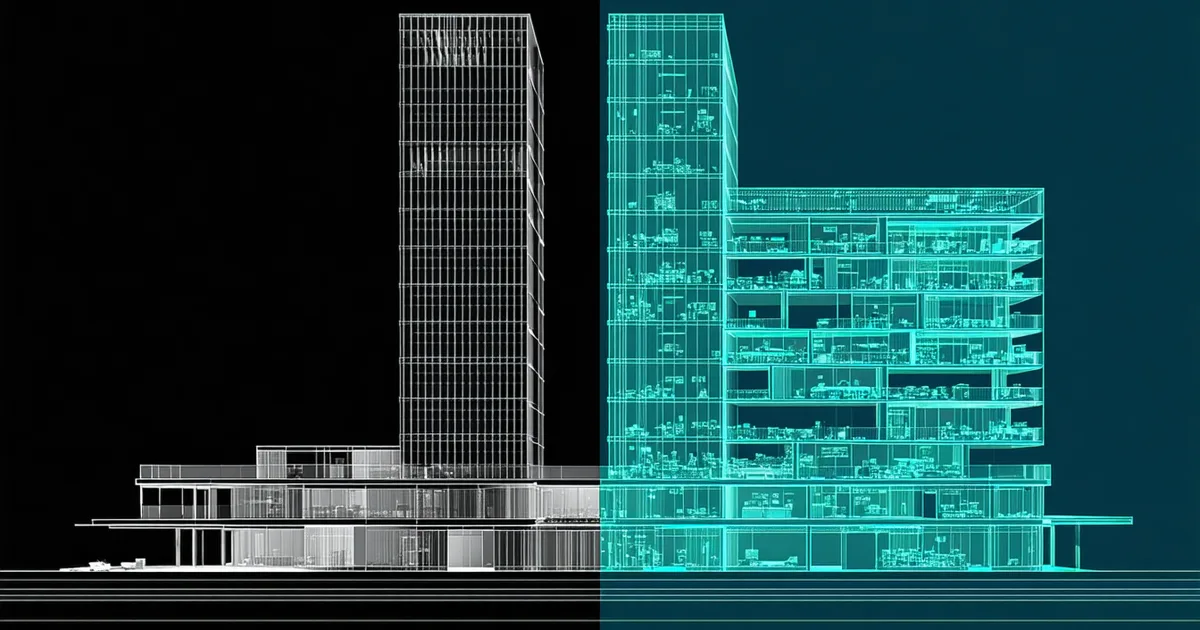
Office-to-residential conversion has become one of the more discussed transaction strategies in US commercial real estate since 2022, as rising office vacancy rates in major CBDs created a class of structurally challenged office assets that can no longer be leased at values that support their debt loads. The thesis is appealing in theory: convert underperforming office to residential, capture housing demand in supply-constrained urban markets, and rehabilitate assets that would otherwise sit vacant.
The valuation challenge is that conversion projects are not straightforward income capitalization problems. They require probability-weighted modeling of entitlement risk, construction cost uncertainty, and post-conversion stabilization assumptions — all of which are substantially more complex than valuing a stabilized income-producing asset.
This piece describes how we approach office-to-residential conversion valuation, specifically the entitlement risk modeling framework and how we translate that risk into a risk-adjusted cap rate for the as-converted property.
Why Office-to-Resi Conversions Are Analytically Different
A stabilized commercial property can be valued with reasonable confidence using a three-tier comp hierarchy and an income capitalization approach. The comp pool anchors the cap rate; the NOI estimate anchors the income line. The confidence interval reflects market pricing variance, not fundamental uncertainty about whether the property can produce income at all.
An office-to-residential conversion project in the entitlement phase has no current NOI. It has a projected NOI that will only materialize if: (1) entitlements are obtained on the expected timeline; (2) the conversion scope is constructable at the estimated cost; (3) the as-converted residential units lease at projected rates; and (4) the project can be stabilized within the projected timeframe. Each of these is a probability-weighted outcome, not a certainty.
Standard comp stacking cannot value a conversion project in this way because there are no "current NOI" and "current cap rate" inputs to anchor the model. What can be modeled is the conditional expected value: the expected NOI assuming the project is successfully completed, discounted by the probability that completion actually occurs on the assumed terms.
The Entitlement Risk Variable
Entitlement risk — the probability that the project obtains the required regulatory approvals on the assumed timeline and budget — is the largest source of uncertainty in a conversion valuation. For office-to-residential conversions specifically, entitlement obstacles typically include:
- Zoning compliance: Office-zoned parcels in most US jurisdictions require a use variance or rezoning to permit residential occupancy. Variance approval timelines vary from 6 months (in cities with active adaptive reuse programs) to 2+ years (in jurisdictions with restrictive zoning structures or high community opposition to increased density).
- Building code compliance: Converting office floor plates to residential use requires meeting residential building code requirements that may be difficult or expensive to achieve in certain building vintages. Floorplate depth, window-to-wall ratios, HVAC configurations, and plumbing infrastructure all present potential conversion barriers.
- Historic preservation review: Office buildings in historic districts or with historic designation may face preservation review that limits or prevents conversion modifications.
- Environmental compliance: ASTM Phase II environmental assessments may be required to confirm that the building and site are suitable for residential occupancy, particularly for properties with prior industrial or lab uses.
Entitlement risk is the probability that the project navigates all of these requirements on the assumed timeline and at the assumed cost. We model this as a single probability weight P_entitlement applied to the as-converted value.
How We Estimate P_entitlement
Estimating P_entitlement for a specific project requires combining:
- Jurisdictional baseline rate: The historical approval rate for comparable adaptive reuse or residential conversion applications in the same jurisdiction. Cities with active adaptive reuse programs (Miami under the Wynwood Adaptive Reuse ordinance, for example) have historically high approval rates; cities where residential zoning is tightly managed have lower baseline rates.
- Site-specific modifiers: Building vintage and floor plate characteristics that affect physical conversion feasibility; environmental history; historic designation status; existing community opposition.
- Program and incentive status: Some jurisdictions have established conversion incentive programs — tax abatements, streamlined permitting, zoning by-right — that materially increase the effective approval probability and shorten the entitlement timeline.
For Miami's CBD and Brickell corridor, where the city has actively supported office-to-residential conversion following the post-2020 migration wave, we apply a jurisdictional baseline P_entitlement of approximately 0.75-0.85 for office assets that meet the physical conversion criteria. For markets with less supportive regulatory environments — certain New York City boroughs, cities with strict preservation requirements — the baseline may be 0.40-0.60.
The Conditional Value Framework
With a P_entitlement estimate in hand, the conversion valuation follows a probability-weighted value framework:
Expected Value = (P_entitlement × V_converted) + ((1 - P_entitlement) × V_office)
Where:
- V_converted = the value of the completed, stabilized residential asset, estimated using a standard comp-adjusted NOI approach for the as-converted product type and location
- V_office = the current value of the office building in its present use (which may be substantially depressed from pre-vacancy values), estimated from current office comp data
This expected value calculation represents the probability-weighted value of the conversion opportunity. It is the maximum rational price for a buyer with a conversion strategy — any price above this expected value represents either overpayment for the uncertainty or a more optimistic P_entitlement assumption than the data supports.
Modeling V_converted: The As-Converted Residential Value
Estimating V_converted requires projecting the stabilized NOI of the completed residential asset. Key assumptions include:
- Unit mix and rentable area: Office floor plates converted to residential typically achieve 55-80% rentable efficiency depending on corridor layouts, plumbing stack locations, and window configurations.
- Pro forma rents per unit: Based on current residential asking rents in comparable nearby buildings — same block and neighborhood, similar unit sizes and amenity levels. This is where the submarket residential rent data feeds in.
- Stabilization vacancy assumption: New residential projects typically achieve 93-95% stabilized occupancy in active urban markets within 12-18 months of delivery. In markets with significant new supply, stabilization timelines extend and initial vacancy allowances should be higher.
- Operating expense load: Residential operating expenses differ materially from office — different insurance profiles, different management cost structures, different amenity and maintenance requirements.
- Cap rate for the as-converted asset: The residential cap rate in the specific submarket post-conversion, derived from multifamily comp transactions in the same geographic market. This is the Valuevynt residential comp pool for the relevant submarket.
Construction Cost as a Value Bridge
The conversion project's construction cost is a value bridge: the gap between V_converted and V_office that needs to be covered by the conversion investment to justify the project economics.
Office-to-residential conversion costs in major US markets have ranged from $90-$250 per square foot of gross building area in recent projects, depending heavily on: building vintage (older buildings with more obsolete systems cost more to convert), floor plate depth (deeper plates require more creative unit configurations and higher mechanical costs), and market labor rates. Miami conversion costs have run $110-$165 per square foot for mid-rise CBD office vintage from the 1980s-1990s, which represents the most common conversion candidate profile.
A project with V_converted = $45M, construction cost = $15M, and P_entitlement = 0.75, V_office = $8M:
Expected gross return = (0.75 × ($45M - $15M)) + (0.25 × $8M) = $22.5M + $2.0M = $24.5M
Maximum rational acquisition price = $24.5M - desired developer margin (typically 15-20% of total project cost)
The Confidence Interval on Conversion Valuations
Conversion project valuations carry inherently wider confidence intervals than stabilized asset valuations, for reasons that extend beyond the usual comp pool depth issues:
- P_entitlement is itself an estimate with variance — the true probability is not knowable with precision
- Construction cost estimates for conversion projects have historically shown 15-25% variance from budget due to unexpected conditions discovered during construction
- Post-conversion residential demand may shift between entitlement date and stabilization if the residential market moves during a multi-year project timeline
We present conversion valuations with explicit sensitivity tables showing the expected value under high, base, and low scenarios for P_entitlement and construction cost. A single point estimate on a conversion project is misleading; the scenario distribution is the analytically useful output.
What This Means for Institutional Buyers of Conversion Candidates
For institutional buyers evaluating office-to-residential conversion candidates, the analytical framework above generates several operational guidelines:
- Do not use office comp data to anchor the acquisition price for a conversion candidate — the relevant comp set is the as-converted residential market, discounted by entitlement probability and construction cost
- Jurisdictional due diligence on entitlement probability is a front-loaded investment that materially sharpens the P_entitlement estimate and narrows the valuation range
- Projects in markets with active adaptive reuse programs and supportive planning departments (like Miami's) command a premium in acquisition pricing for the improved entitlement probability they offer
- The construction cost bridge must be stress-tested against realistic current construction cost data for the specific market and building type — using 2021 cost estimates in a 2025 acquisition will understate the required investment by 20-35%
Office-to-residential conversion remains a viable strategy in the right markets and at the right acquisition prices. The analytical discipline required to value it properly — probability-weighted entitlement modeling, as-converted residential comp analysis, construction cost bridging — is more complex than standard income capitalization but is tractable with the right framework. The wide confidence intervals that result are not a problem to be solved away; they are an accurate reflection of the inherent uncertainty in development-stage investments.