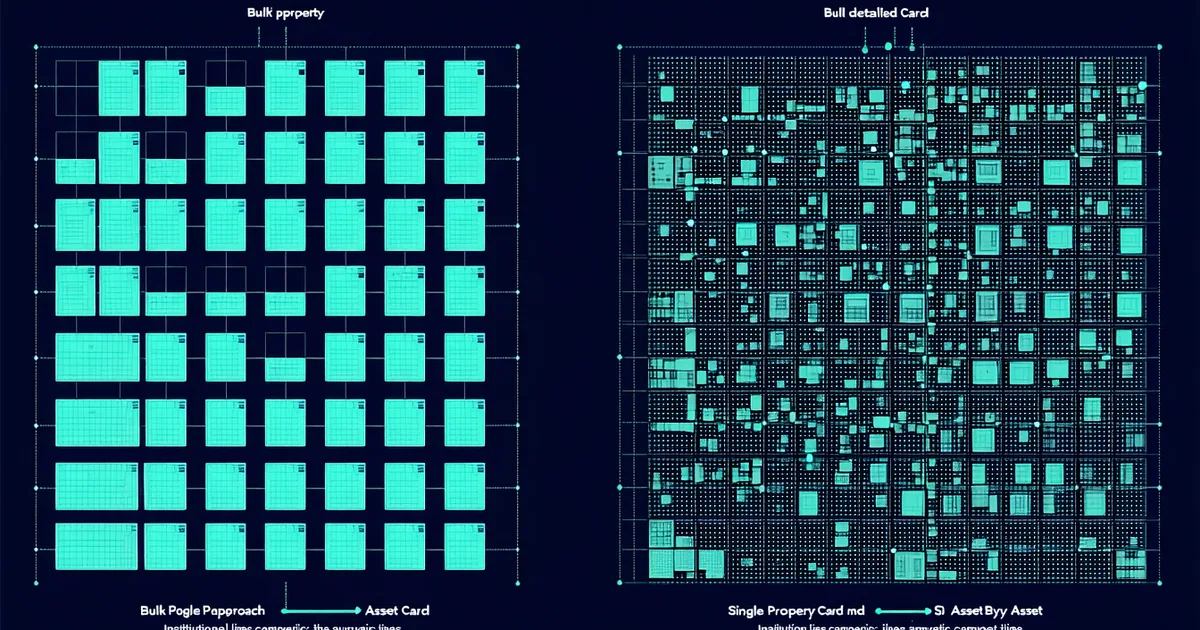
Portfolio valuation frequency is one of the most consequential and underexamined operational decisions in institutional real estate asset management. REITs, pension funds, and open-end real estate funds all face a version of the same problem: how often should the values in the portfolio be updated, and what methodology should drive those updates?
The conventional answer — annual or quarterly third-party appraisals — persists because it is defensible, established, and familiar. But it carries real costs: direct appraisal expenditure, the time lag between market conditions and reported values, and the risk of material divergence between book value and market value that compounds silently between formal revaluation cycles.
This piece examines the economics and decision framework for REIT portfolio revaluation frequency, with specific attention to how automated continuous valuation changes the trade-off.
The Cost of the Status Quo
A formal USPAP-compliant commercial property appraisal costs between $2,000 and $12,000 per asset, depending on asset type, size, complexity, and geography. For a diversified REIT with 300 assets, an annual third-party appraisal program represents a direct expenditure of $600,000 to $3.6M per year — a material but typically unquestioned line in the asset management budget.
Beyond the direct cost, there is a lag problem. An appraisal commissioned in October reflects market conditions as the appraiser observed them through the comparable sales period — typically 6-18 months of historical transactions. In a market environment where cap rates are moving 20-40bps per quarter, a formal appraisal completed in November for a Q4 reporting package may be incorporating comp evidence from a market that was materially different than today. The reported NAV may be systematically stale.
For non-traded REITs and open-end real estate funds — where redemption pricing is based on NAV — this staleness has direct economic consequences for investors entering and exiting the fund. NCREIF data has documented the appraisal smoothing phenomenon for decades: appraisal-based valuations in periods of market stress tend to lag the actual price discovery occurring in the transaction market by two to four quarters.
What Drives the Need for More Frequent Revaluation
Several structural factors create a case for more frequent portfolio valuation beyond the annual appraisal cycle:
Loan Covenant Monitoring
Many institutional CRE loans include LTV-based maintenance covenants. A portfolio lender that relies on the previous annual appraisal as the basis for LTV monitoring may be operating with a value assumption that diverges significantly from current market — in both directions. In a falling market, this creates undisclosed covenant risk; in a rising market, it prevents borrowers from extracting available equity. Monthly or quarterly automated revaluation of pledged collateral enables real-time covenant headroom tracking without the appraisal expenditure cycle.
Acquisition Comparison
When an acquisition team is evaluating a new asset to add to the portfolio, comparing the new asset's pricing against the current book value of comparable assets in the existing portfolio requires that the book values reflect current market conditions. If the book includes assets last appraised 9 months ago in a market that has moved 30bps on cap rates since then, the comparison is misleading. Continuous valuation of the existing portfolio creates an accurate basis for this comparison.
Lease Rollover Risk Flagging
Portfolio assets where major leases are approaching expiration carry forward risk that is amplified by weak submarket fundamentals. Monthly or quarterly revaluation that incorporates current vacancy and absorption trends will capture the value erosion attributable to rollover risk as it materializes — not after the lease has already expired and a formal appraisal reflects the vacancy.
Regulatory and Investor Reporting
SEC guidance on fair value measurement (ASC 820) calls for portfolio values to reflect the price at which an asset could be exchanged in an orderly market transaction between market participants. Annual appraisals are generally accepted as a practical implementation of this standard, but the standard itself does not mandate annual frequency. More frequent valuation updates, where they improve the accuracy of fair value estimates, support the regulatory intent.
A Framework for Revaluation Frequency Decision-Making
Optimal revaluation frequency is not uniform across a portfolio. Different asset types and market conditions warrant different cadences.
Annual Formal Appraisal: When It Is the Right Answer
Full USPAP appraisals remain appropriate for:
- Loan origination and refinancing — lenders require formal appraisals regardless of whether the borrower has automated valuations available
- Fund investor reporting where formal appraisal is specified in the fund documents
- Litigation, estate valuation, or regulatory examination where a defensible, qualified appraisal is required
- Complex assets where automated models produce wide confidence intervals — ground leases, development sites, major repositioning projects — and manual judgment is required for defensible output
Quarterly Automated Revaluation: The Monitoring Layer
For standard institutional assets — stabilized multifamily, NNN retail, flex industrial, Class A and B office — quarterly automated revaluation using a comp-adjusted NOI model provides the market signal freshness that annual appraisals cannot deliver, at a fraction of the cost. The quarterly cadence aligns with LP reporting cycles and enables covenant headroom calculations that are meaningfully more current than annual appraisals.
The economics of automated portfolio revaluation change the calculus fundamentally. At $299-$3,499 per month for unlimited portfolio coverage versus $1.5-3.6M per year in formal appraisal fees for a 300-asset REIT, the question is no longer whether to automate monitoring — it is how to calibrate the combination of automated monitoring and formal appraisal to serve different purposes.
Event-Triggered Revaluation: The Risk Management Layer
Beyond scheduled cadence, automated systems can trigger revaluation based on market events: a submarket vacancy increase above a threshold, a significant CMBS delinquency cluster emerging in a relevant geography, or a cap rate movement of more than 25bps on recent comparable transactions. Event-triggered revaluation ensures that the portfolio's value estimates are updated when the market moves, not just when the calendar dictates.
The Confidence Interval Problem in Continuous Valuation
One legitimate concern about increasing valuation frequency is the accuracy of high-frequency estimates in thin markets. For assets in markets with low transaction volume, quarterly automated valuations may be drawing on a comp pool that has not meaningfully changed since the last quarterly run — in which case the new estimate is not more accurate than the previous one, it is just more recent.
The appropriate response to this concern is not to avoid high-frequency valuation but to disclose the confidence interval explicitly with each estimate. A quarterly valuation for a Miami Brickell Class A office asset in a quarter with no new comparable transactions should output a wide confidence interval that reflects the thin comp pool — the analyst should treat this as a signal that the estimate is less precise, not that the system is failing.
Markets with robust transaction activity — Phoenix multifamily, Chicago industrial, Dallas mixed-use — will produce tight confidence intervals on quarterly automated estimates. Markets with thin transaction activity — tertiary market NNN retail, specialty assets — will produce wide intervals. Both are appropriate outputs; the analyst's job is to interpret the interval as information about the quality of the estimate, not just as a price range.
Building the Hybrid Program
The practical implementation for most REIT asset management teams is a hybrid program:
- Annual formal appraisal: All assets, for regulatory, lender, and fund document compliance purposes. Total cost $1.5M-$3.5M for a 300-asset portfolio.
- Quarterly automated revaluation: All assets, for management monitoring, covenant compliance, and acquisition comparison purposes. Total cost $10,000-$42,000 per year for a 300-asset portfolio using a platform like Valuevynt.
- Event-triggered revaluation: Specific assets where market signals (vacancy increase, CMBS distress, lease rollover within 12 months) warrant off-cycle attention.
This hybrid program produces meaningfully more current portfolio intelligence than the annual-only program at a cost that is a fraction of the incremental formal appraisal cost. The formal annual appraisal retains its role as the defensible, qualified valuation for regulatory and transactional purposes; the automated quarterly layer provides the management visibility that the annual program alone cannot deliver.
Implementation Considerations
For REIT asset management teams evaluating automated continuous valuation, several implementation questions are worth working through before onboarding:
- How do you want to handle assets where the automated estimate diverges significantly from the most recent formal appraisal? Setting a divergence threshold — say, 10% — that triggers a review process ensures that material discrepancies are flagged rather than silently incorporated.
- What is the appropriate governance structure for automated valuation outputs? Automated estimates should be clearly labeled as internal monitoring tools, not fair value determinations for external reporting, until they have been reviewed and approved by a qualified professional.
- How does the automated estimate feed into LP reporting packages? Most open-end fund documents require formal appraisals for NAV calculation; automated estimates should supplement, not replace, the formal process until the documentation is updated.
The revaluation frequency question is ultimately a risk management question: how current does your portfolio's value intelligence need to be to support the decisions you are making with it? For most institutional REIT asset management teams, the answer is more current than annual formal appraisals alone can provide.